Oregon Advance Directive: Why Naming Someone Isn’t Enough

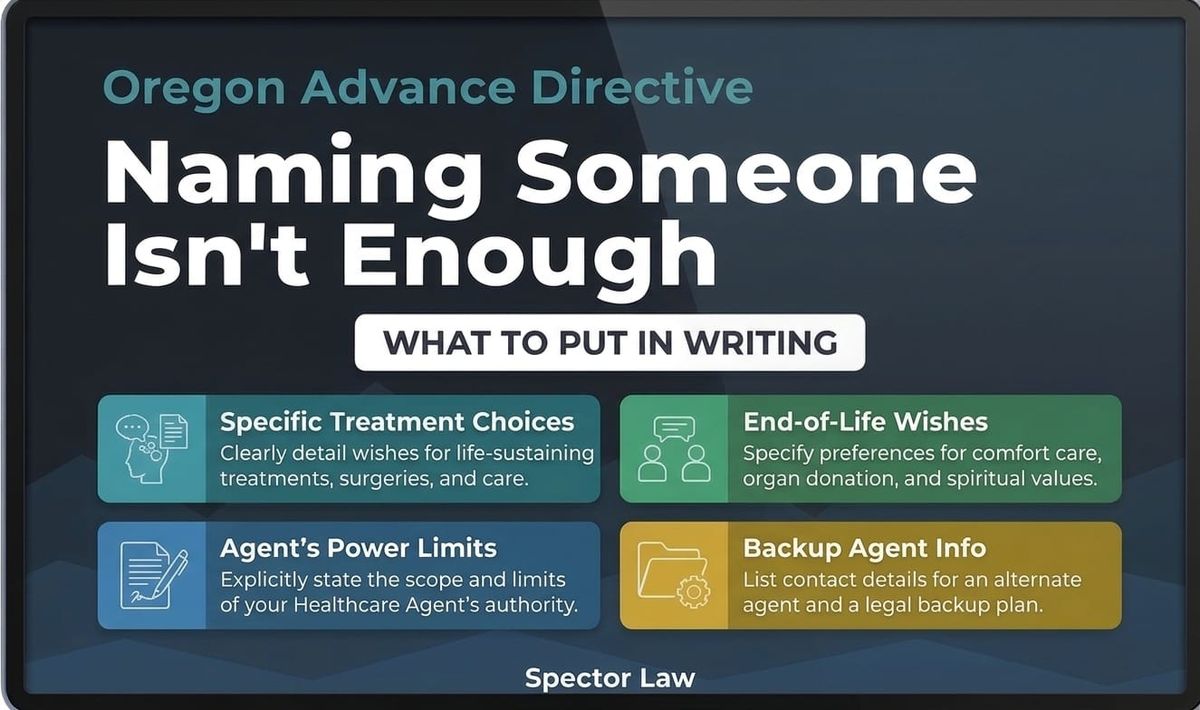
Most people name a health care representative, initial "let them decide," and stop. In Oregon, that's not enough. Your representative's authority is limited by law, and the gaps show up in the hardest situations.
If You Haven't Named Anyone
In an emergency, hospital staff try to reach your loved ones through the emergency contacts in your phone, your medical records, and your wallet. Whether those people can legally make decisions for you depends.
For life support decisions, if you haven't named anyone, Oregon law (ORS 127.635) sets the order doctors turn to:
- Your legal guardian, if you have one
- Your spouse
- A majority of your adult children
- Your parents
- A majority of your adult siblings
- Any adult relative or friend
If you'd want a close friend making these calls, they're last on that list.
The Form
Oregon's Advance Directive is free. Get it from a .gov website, where it's available in several languages. Versions on other sites may be outdated.
The form asks you to:
- Name a health care representative and an alternate
- Choose what you want if you have a terminal condition, an advanced progressive illness (such as Alzheimer's), or are permanently unconscious
- Explain what matters most to you in Section B
- Sign with witnesses or a notary
Your representative can accept by signing the form or simply by telling your doctor they're there to serve. You don't have to chase down their signature.
Your Representative's Authority Is Limited
You make your own decisions as long as you can communicate, even with a blink or a thumbs up. Your representative steps in only when you can't, such as during surgery or a coma.
I often hear, "Susie knows me best. Let her decide." If you have a Susie, that's wonderful. But under ORS 127.540, Susie can't make certain decisions for you, including abortion, sterilization, certain psychiatric treatments, and withholding or withdrawing life support except in very specific circumstances, and even then, only if you gave her that authority or specific medical conditions are met.
Put the Hard Situations in Writing
If any of these could apply to you, write your wishes down in your own words:
- Pregnancy. If you could become pregnant and were in a car accident with no brain activity, what should happen if you're pregnant and can't make decisions?
- Mental health. If schizophrenia runs in your family, how do you feel about psychiatric care?
- Alzheimer's. Initialing "comfort care" may not be enough.
On that last one: Oregon law says "artificially administered nutrition and hydration" doesn't include food or water given by cup, hand, bottle, straw, or utensil (ORS 127.505(4)(b)). So declining artificial hydration and nutrition doesn't necessarily decline spoon-feeding.
This issue has made the news. In September 2016, the Associated Press and KGW reported on Nora Harris, an Ashland woman with early-onset Alzheimer’s whose advance directive asked that her life not be prolonged. According to those reports, the nursing facility to continued spoon feeding her for hydration and nutrition, and her husband’s court challenge was unsuccessful.
If you do want nutrition or hydration at all in that situation, say so expressly. For example: “Under no circumstances do I want to be spoon-fed food or water.”
Set Your Representative Up to Succeed
- Get the form from a .gov website
- Name a representative and an alternate
- Fill out Section B as fully as you can
- Attach pages for any specific situations, in your own words, signed and dated
- Sign with witnesses or a notary
No form guarantees an outcome. Specific written instructions give your representative something concrete to point to. The statutes (ORS 127.505 to 127.660) and the form change over time, so talk with an attorney about your situation.
Whether you work with me or someone else, promise me one thing: please get your estate planning done in the next 90 days. No one plans to have a heart attack on a Tuesday, and a plan only helps if it's already in place.
Watch the full video on YouTube. Ready to talk? Schedule a call with my team.
Rugged plans, built to last.
This article is for general information and educational purposes only. It is not legal advice and does not create an attorney-client relationship.